Skip to content

At ClearSight, we talk to patients every day who tell us some version of the same story: they thought about LASIK for years — sometimes over a decade — before finally scheduling a consultation. The reasons vary, but the feeling after is almost always the same. Relief. And the quiet regret of time spent waiting. This article is for everyone still sitting with that hesitation.
The 15-Year Delay: Why So Many People Put Off LASIK
Most people who eventually get LASIK don’t do it right away. The research tracks people from consultation to surgery, not from their first casual thoughts about LASIK, so we do not have hard data on how many years most people ‘think about it’ before taking action. However, from our experience talking with patients, many put it off for a lot of the same reasons.
The hesitation is understandable. Life is busy, cost feels daunting, and anything involving the eye naturally triggers caution. But “I’ll think about it next year” has a way of becoming fifteen years of corrective lenses, fogged-up glasses on cold mornings, and contact lenses that dry out by noon. The delay isn’t usually one big decision — it’s the absence of a decision, repeated daily.
The Small Moments You Don’t Realize You’re Losing
When you depend on glasses or contact lenses every day, you stop noticing what you’re working around. You don’t realize you’ve stopped swimming without hesitation, or that you instinctively reach for your glasses before you can clearly see your child’s face in the morning. Impaired visual perception becomes normal, and normal stops feeling like a limitation.
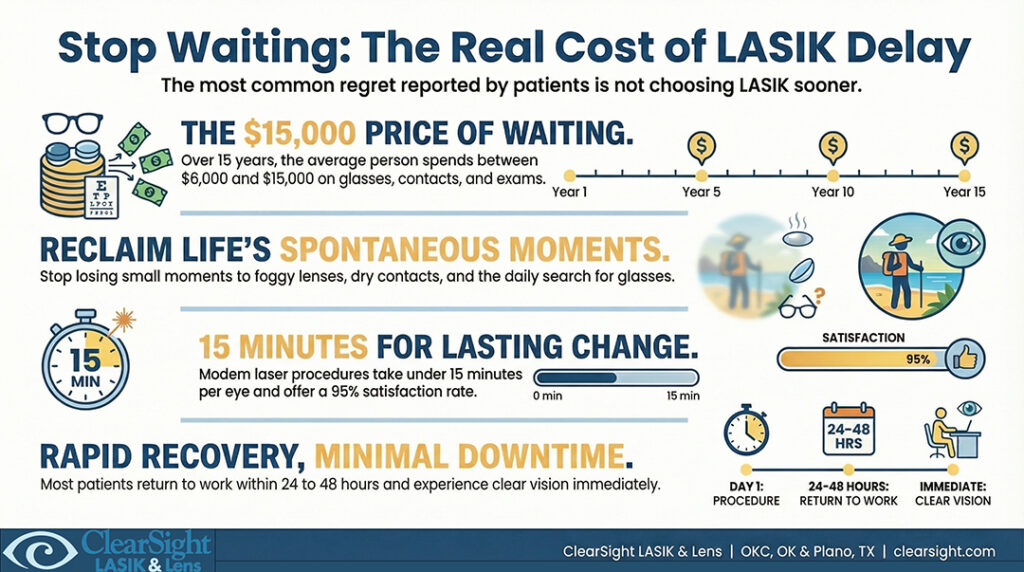
Our patients often describe a specific moment after LASIK when it hits them — waking up, seeing clearly, and thinking: I can’t believe I lived like that. The losses before surgery aren’t dramatic. They’re small: a spontaneous nap without removing contact lenses, rain on your face without ruined lens coatings, hiking without the anxiety of losing a contact to wind or dust. These things accumulate quietly over years, and you only recognize them once they’re no longer a problem.
The Fear Factor: What Keeps Most People From Booking the Consultation
Fear is the most common reason people delay LASIK, and it’s worth addressing directly. The top concerns we hear:
Fear of the procedure itself. LASIK is a laser-based eye surgery that reshapes the cornea to correct refractive errors including myopia and astigmatism. The procedure takes under 15 minutes per eye. Most patients report minimal discomfort.
Fear of complications. LASIK has been performed for over 30 years. Clinical data consistently shows patient satisfaction rates above 95%, with serious complications being rare. At ClearSight, every candidate undergoes a thorough exam — including corneal topography and detailed corneal mapping — before surgery is ever recommended.
Fear of cost. This is real and worth examining — but it’s also a calculation most people haven’t fully made. More on that below.
Fear of not being a candidate. This concern stops many people from scheduling at all. The reality: you won’t know until a physician evaluates your eye health, your eyeglass prescription, and your cornea in detail — and at ClearSight, that exam is free.
Much of the fear circulating today traces back to early LASIK technology from the 1990s. Modern ophthalmology is a different landscape entirely.
The Real Cost of Waiting — And It’s Not Just Financial
Here’s the math most people haven’t run: the average person spends between $400 and $1,000 per year on glasses, contact lenses, lens solution, and routine eye exams. Over 15 years, that’s $6,000 to $15,000 — often more than the one-time cost of LASIK surgery.
And that figure doesn’t account for the non-financial cost. Contact lens-related infections are more common than most patients expect. The ongoing dependency on corrective lenses disrupts everyday life in ways that add up — travel, sports, sleep, any moment where spontaneity should be possible. There’s also the quieter toll of feeling tethered to a routine that only exists because your eyes need help.
LASIK isn’t free. But waiting has a cost too — it just arrives in smaller increments, which makes it easier to overlook.
Are You Ready for ClearSight?
Take Our Self-Test to See Which Vision Correction Procedure Is Right For You
What the First Week of Clear Vision Actually Feels Like
The morning after LASIK, most patients do the same thing: they wake up, open their eyes, and pause. Not because something is wrong — because something is right.
The first week isn’t without adjustment. Dry eyes and mild light sensitivity are common and typically resolve within a few days. But even with those temporary side effects, the results consistently exceed patient expectations. Within 24 to 48 hours, most people are back at work. The procedure was brief. Recovery was manageable. And the outcome is something they spent years putting off.
The most common thing ClearSight patients say in the days after surgery: “I should have done this years ago.”
What I Wish Someone Had Told Me Before I Spent a Decade in Glasses
Here’s the practical advice that would have changed the timeline for most of our patients — had someone said it sooner:
-
The consultation is free. You are not committing to surgery by scheduling an exam.
-
The procedure itself is under 15 minutes per eye. It is not the lengthy surgery most people imagine.
-
Financing exists. At ClearSight, we offer guaranteed 0% financing — the barrier of a large upfront cost doesn’t have to be the reason you wait.
-
Most patients return to work the next day. Downtime is minimal compared to nearly any other type of surgery.
-
Modern LASIK is not what it was in 1997. Early-generation concerns do not apply to today’s laser platforms and advanced diagnostic tools like corneal topography.
Had this been the advice a decade earlier, the decision would have looked different.
How to Know If You’re Ready (Hint: You Probably Already Are)
Basic LASIK candidacy requirements include a stable eyeglass prescription for at least one year, good eye health, and being 18 or older. Myopia, astigmatism, and many forms of farsightedness are the exact conditions LASIK was designed to treat. A ClearSight physician will evaluate all of this during your free consultation — including a full corneal assessment and a review of your overall health history.
But readiness isn’t only a medical question. Are you tired of glasses? Do contact lenses interrupt your everyday life more than you’d like to admit? Have you been thinking about this for more than a year?
If yes — you already know where this is going.
The only thing between where you are now and clear vision without corrective lenses is a single appointment with a professional who can give you a straight answer about your options.
Schedule your consultation at ClearSight today. The only regret our patients report is not doing it sooner.