Skip to content

Two patients with the same goal of reducing their dependence on glasses can end up with two different procedures. What separates them is measurable: the thickness of the cornea and the strength of the prescription.
EVO ICL vs LASIK: Which Is Right for Me?
The choice between EVO ICL and LASIK is determined primarily by corneal thickness and prescription strength, with EVO ICL indicated for higher prescriptions and thinner corneas. LASIK reshapes corneal tissue with a laser. An implantable collamer lens (EVO ICL) adds a lens inside the eye and removes no corneal tissue. Corneal measurements taken at consultation determine which procedures a patient qualifies for.
ClearSight LASIK & Lens performs both LASIK and EVO ICL and have some of the most experience in the OKC and Dallas markets. Dr. Luke Rebenitsch, MD and the ClearSight team make sure the correct procedure is chosen for you to optimize your final quality of vision.
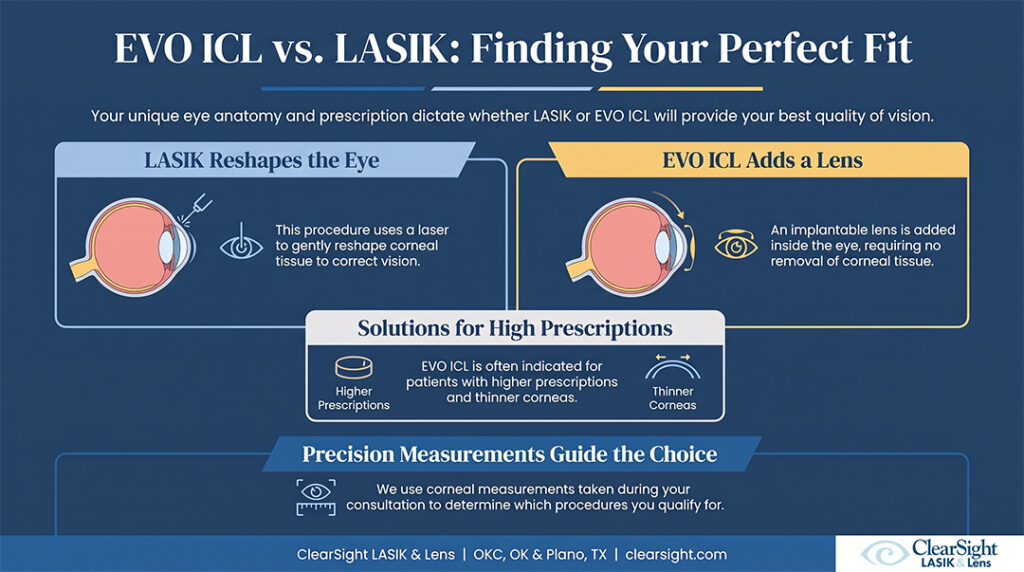
How Is EVO ICL Different from LASIK in How the Procedure Works?
LASIK reshapes the cornea with a laser, while EVO ICL places a lens made of collamer, a biocompatible material, inside the eye behind the iris without removing corneal tissue. LASIK is subtractive; corneal tissue is removed to change how light focuses. EVO ICL is additive. The collamer lens sits in front of the natural lens and does not replace it. Both are performed on an outpatient basis, with suitability determined by individual eye anatomy.
Is EVO ICL or LASIK Better for a High Prescription or Thin Corneas?
EVO ICL is indicated for higher prescriptions and thin corneas because it requires no corneal tissue removal, which is the constraint that limits LASIK in both situations. FDA labeling covers spherical equivalent from −3.0 D to −20.0 D in patients aged 21 to 60, a range expanded from 21 to 45 in February 2026. Thin corneas limit LASIK because reshaping requires removing tissue the cornea needs for structural strength. EVO ICL removes no tissue.
Dr. Luke holds the Fellow of the World College of Refractive Surgery credential (FWCRS), held by fewer than 3.33% of LASIK surgeons nationwide, and is one of only two WCRS Fellows in Oklahoma. High prescriptions and borderline corneal thickness are where that evaluation experience carries the most weight.
Which Is Better for Someone Prone to Dry Eyes, EVO ICL or LASIK?
For patients with existing dry eye, EVO ICL is generally the more suitable option because it does not require creating a corneal flap. LASIK flap creation transects corneal nerves involved in tear production, and those nerves regenerate over time. EVO ICL uses a small self-sealing incision. Dry eye after LASIK is typically temporary, and pre-existing dry eye is evaluated and often treated before either procedure is scheduled.
How Do Night Vision and Halos Compare Between EVO ICL and LASIK?
Glare, halos, and starbursts can occur after either procedure during early recovery, and these effects typically diminish as the eye heals. Pupil diameter and prescription strength are the primary risk factors for both. The mechanisms differ. LASIK-related effects relate to the treated corneal zone relative to pupil size; EVO ICL effects relate to the lens optic and pupil dynamics. Pupil measurements taken at consultation inform both the procedure choice and the treatment parameters.
Are You Ready for ClearSight?
Take Our Self-Test to See Which Vision Correction Procedure Is Right For You
How Does Recovery Time Differ Between EVO ICL and LASIK?
Both EVO ICL and LASIK offer rapid visual recovery, with most patients noticing improvement within the first day, and the procedures differ more in post-operative restrictions than in recovery speed. EVO ICL is intraocular surgery, with early restrictions on eye rubbing, swimming, and heavy lifting. LASIK adds flap protection precautions. Recovery varies by individual healing, and the surgeon sets the restrictions specific to the procedure performed.
How Much More Does EVO ICL Cost Than LASIK?
EVO ICL typically costs more per eye than LASIK because it involves a custom-manufactured implantable lens selected for the individual eye. LASIK uses no implant. EVO ICL also involves intraocular surgery rather than surface laser treatment. Cost varies by prescription and by the astigmatism correction required, and both procedures are quoted per eye at consultation.
Can EVO ICL Be Removed or Reversed, and Can LASIK?
The EVO ICL lens can be removed or exchanged by a surgeon, while LASIK reshapes corneal tissue, and that reshaping cannot be undone. Removability means the lens can be exchanged if vision needs change over the years, and it does not preclude later procedures such as cataract surgery. Removal is uncommon. Most patients retain the lens long term, and the cornea’s structure is left unaltered.
ClearSight LASIK & Lens states its outcome standard through the 20/20 or It’s Free Commitment, the same standard Dr. Luke applies whether a patient’s measurements point toward LASIK or toward EVO ICL. Removability allows for greater versatility in the future should further vision correction be needed.
How Does a Consultation Determine Which Procedure Is Right for Me?
A consultation determines the procedure through specific measurements: corneal thickness and topography, prescription and refractive stability, pupil size, and anterior chamber depth. Corneal thickness and topography determine LASIK viability. Anterior chamber depth, the depth of the space at the front of the eye, and prescription strength determine EVO ICL viability under the FDA-approved parameters current as of 2026. Refractive stability over the prior year is required for both.
ClearSight LASIK & Lens offers free consultations, and because Dr. Luke performs both LASIK and EVO ICL, a single evaluation covers candidacy for both. ClearSight LASIK & Lens has completed 35,000+ procedures and holds 1,123+ Google reviews averaging 4.9 stars.
Key Takeaways: EVO ICL vs LASIK
-
The choice between EVO ICL and LASIK is determined primarily by corneal thickness and prescription strength, both measured during consultation.
-
LASIK reshapes corneal tissue with a laser; EVO ICL adds a collamer lens inside the eye without removing corneal tissue.
-
EVO ICL is FDA-indicated from −3.0 D to −20.0 D for patients aged 21 to 60, a range expanded from 21 to 45 in February 2026.
-
Patients with thin corneas or existing dry eye are frequently EVO ICL candidates, since the procedure requires no corneal flap.
-
The EVO ICL lens can be removed or exchanged by a surgeon; LASIK’s corneal reshaping cannot be undone.
ClearSight LASIK & Lens performs both LASIK and EVO ICL in Oklahoma City, serving patients from Edmond, Norman, and Central Oklahoma. Dr. Luke Rebenitsch, MD, FWCRS, a board-certified ophthalmologist, is the owner and medical director. Because both procedures are performed in-house, candidacy for each is evaluated in the same visit.
Schedule your free consultation at ClearSight LASIK & Lens to find out which procedure your measurements support.
Related Resources
Anna Edmiston, MD
Board-Certified Ophthalmologist
Last reviewed on August 17, 2026