Skip to content

Custom Lens Replacement, also called refractive lens exchange (RLE), and cataract surgery are easy to confuse because they involve the same part of the eye. What sets them apart is the reason the procedure is done.
How does Custom Lens Replacement differ from cataract surgery?
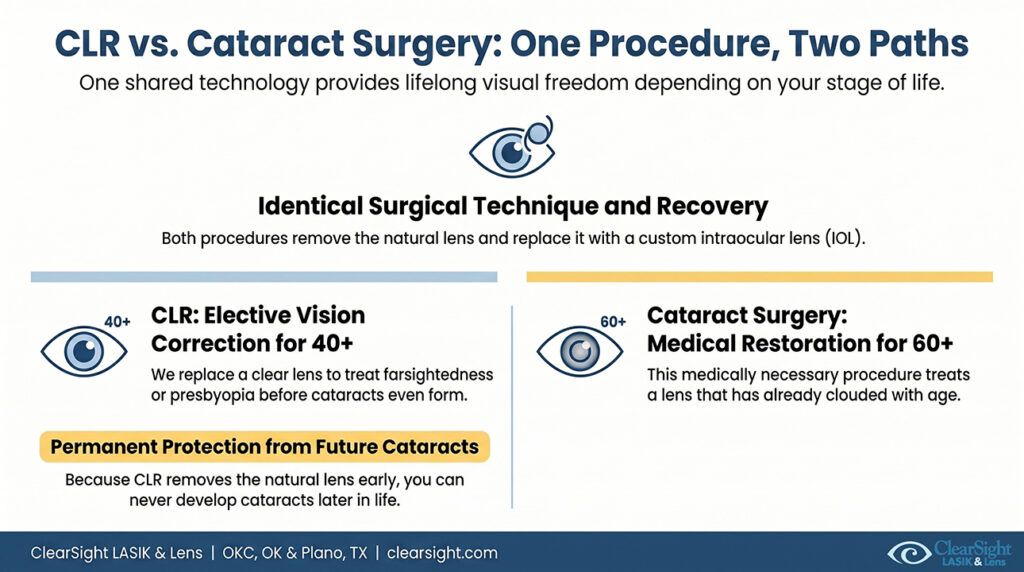
Custom Lens Replacement and cataract surgery use the same surgical procedure — removing the eye’s natural lens and replacing it with an artificial intraocular lens (IOL). The difference is the medical indication: cataract surgery treats a lens that has clouded with age, while Custom Lens Replacement electively replaces a clear lens to correct refractive errors such as farsightedness or presbyopia.
At ClearSight in Plano, Dr. Anna Edmiston performs both Custom Lens Replacement and cataract surgery. What sets ClearSight apart is the focus on detail. Every patient is brought in for a post op visit to determine if any fine tuning can be done to optimize vision further.
Is Custom Lens Replacement the same procedure as cataract surgery?
Yes — Custom Lens Replacement and cataract surgery are the same surgical procedure performed for different reasons. Both remove the eye’s natural lens and replace it with an artificial intraocular lens. Cataract surgery removes a lens that has clouded with age, while Custom Lens Replacement removes a still-clear lens to correct refractive error, often before a cataract develops.
Who is Custom Lens Replacement for, and who is cataract surgery for?
Cataract surgery is performed for patients whose natural lens has clouded enough to impair vision, most commonly adults over 60. Custom Lens Replacement is an elective option for adults — typically 40 and older — who want to reduce dependence on glasses or contacts and address presbyopia or significant refractive error before cataracts form.
Dr. Anna Edmiston evaluates candidacy for both procedures during a comprehensive consultation at ClearSight in Plano, assessing factors such as age, visual demands, and anatomy. She would rather do no surgery than to perform one on someone who is not an ideal candidate.
Custom Lens Replacement (CLR) Cataract Surgery Procedure Removes natural lens, replaces with an IOL Removes natural lens, replaces with an IOL (same technique) Reason Elective — correct refractive error / presbyopia Medical — treat a clouded natural lens Typical age 40+ 60+ (when cataract impairs vision) Insurance Generally not covered (elective) Typically covered by insurance/Medicare IOL options Monofocal, multifocal, EDOF, toric, light-adjustable Same range available Cataracts afterward? No — natural lens is gone N/A — cataract already being removed Recovery Days to clearer vision; weeks to stabilize Same
Are the lens implant (IOL) options the same for both procedures?
The intraocular lens options are largely the same for both procedures. Monofocal, multifocal, extended-depth-of-focus, toric, and light-adjustable lenses can be used in cataract surgery and Custom Lens Replacement alike. The right lens depends on a patient’s vision goals and eye anatomy rather than on which procedure is performed.
Is cataract surgery covered by insurance when Custom Lens Replacement is not?
In most cases, yes. As of 2026, cataract surgery is typically covered by medical insurance and Medicare because it treats a medical condition — a clouded lens that impairs vision. Custom Lens Replacement is generally considered elective and is not covered, since it corrects refractive error rather than treating disease. Premium lens upgrades can carry out-of-pocket costs in either procedure.
Can someone still develop cataracts after Custom Lens Replacement?
No. Once the natural lens is removed during Custom Lens Replacement, a cataract cannot form, because a cataract is a clouding of that natural lens. The artificial intraocular lens does not develop cataracts. Some patients later notice clouding of the thin membrane behind the lens — called posterior capsule opacification — which is treated with a brief laser procedure.
Are You Ready for ClearSight?
Take Our Self-Test to See Which Vision Correction Procedure Is Right For You
At what age is Custom Lens Replacement vs cataract surgery typically performed?
Custom Lens Replacement is typically performed for adults 40 and older who want to reduce reliance on glasses, often before cataracts develop. Cataract surgery is usually performed later — most commonly after age 60 — once a cataract has clouded the natural lens enough to affect daily vision. As of 2026, timing depends on individual eye health, not age alone.
At ClearSight in Plano, Dr. Anna Edmiston offers Custom Lens Replacement for patients 40 and older and premium cataract surgery for older patients. She also offers four other forms of vision correction, which the patient would be evaluated for as well.
How do recovery times compare between Custom Lens Replacement and cataract surgery?
Recovery is similar for both procedures because they use the same technique. Most patients notice clearer vision within a few days, with vision continuing to stabilize over several weeks. Many people resume normal daily activities within 24 to 48 hours. Eye drops are typically used for a few weeks, and strenuous activity is limited briefly during early healing.
Patients in Plano and the DFW area can review recovery expectations for both procedures with Dr. Anna Edmiston. Most patients are seeing their phones and computers without glasses within days of the procedure.
Patients in Plano and the DFW area can schedule a free consultation at ClearSight to learn whether Custom Lens Replacement or cataract surgery fits their vision needs.
Related Resources
Medically Reviewed By:
Luke Rebenitsch, MD
Board-Certified Ophthalmologist
Fellowship Trained Refractive Surgeon, WCRS
Last reviewed on June 26, 2026